



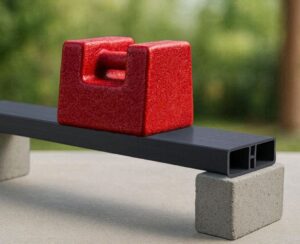
What Load Can a Universal PVC Profile Withstand?
One of the most common questions from customers is: “How much load can a universal PVC profile withstand?”
At first glance, the answer seems simple — just provide a number in kilograms. However, in practice, it is much more complex. For any structural material, not only the load itself matters, but also the conditions under which it is applied. That is why it is impossible to define a single universal load value for all applications of PVC profiles.
Why It Is Impossible to Say: “It Withstands 100 or 200 kg”
Let us consider two situations.
In the first case, the profile is 1 meter long and rests on a continuous support. In the second case, the same profile is 3 meters long and fixed only at its ends. Obviously, the result under the same load will be different.
The performance of the profile depends on:
- span length between supports;
- mounting method;
- number of support points;
- load direction;
- operating temperature;
- load duration;
- overall structural design.
Therefore, the same weight can be completely safe in one structure and cause significant deflection in another.
What Matters More: Strength or Deflection?
Many people mistakenly assume that the key parameter is the maximum load until failure.
In reality, in most household and construction applications, the decisive factor is not failure, but stiffness and the amount of deflection under load.
PVC profiles have sufficient strength for many applications. However, deflection may occur long before the material reaches its ultimate load capacity. For some applications this is acceptable, for others it is not.
For example, in a bench, a slight deflection under a person’s weight is a natural phenomenon and does not affect safety. For decorative or cladding elements, stiffness requirements may be significantly higher.
Orientation of the Profile Matters
One of the key factors is how the profile is installed.
The same profile can behave differently depending on its orientation within the structure.
When installed flat (wide side horizontal), it has one level of stiffness. When placed on edge, resistance to bending increases significantly.
A simple example can be seen with a wooden board: placed flat between two supports, it bends easily; placed on edge, it becomes much stiffer without any change in material or weight.
The same principle applies to universal PVC profiles.
That is why structural design must consider not only the load, but also the orientation of the profile.
Comparison with Wooden Battens
Customers sometimes compare PVC profiles with wooden battens or boards of similar size.
In reality, the structural principle is very similar. Wood also does not have a single value of “how much weight a board can carry.” Engineers always consider span length, number of supports, allowable deflection, and mounting method.
Therefore, for both wooden and PVC materials, the key factor is proper structural design, not an abstract load number.
Use in Benches and Outdoor Furniture
Universal PVC profiles are widely used in benches, garden furniture, decorative structures, fences, and other applications.
However, when creating seats or structures approximately 1.5 meters long or more, we strongly recommend adding a central support or transverse reinforcement.
This solution allows you to:
- reduce deflection under load;
- increase structural rigidity;
- improve user comfort;
- distribute load more evenly;
- extend product lifespan.
An additional support is especially important for benches used frequently by adults or installed in public spaces.
How to Properly Evaluate Load
When selecting a universal PVC profile, it is recommended to consider not only the possible load, but the entire structure:
- element length;
- number of supports;
- mounting method;
- profile orientation;
- operating conditions;
- allowable deflection level.
A comprehensive approach ensures a reliable and durable structure.
Conclusion
Universal PVC profile is a strong, durable, and practical material for a wide range of applications. However, its performance always depends on the specific design and operating conditions.
Therefore, when evaluating load capacity, it is important to consider not only weight, but also span length, mounting method, profile orientation, and additional supports.
Proper structural design ensures maximum reliability, user comfort, and long service life of products made from universal PVC profiles.